 7df366d0c8
* feat(capture): dictation, personalities, 0.5.0

Ships the Capture release end to end. Global-hotkey dictation with
synthetic paste into the focused app on macOS and Windows, an on-screen
pill across recording / transcribing / refining, customizable push-to-
talk and toggle chords, and an accessibility-permission prompt scoped to
Settings → Captures with inline re-check feedback.

Voice profiles gain optional personalities that power compose / rewrite /
respond actions via a local Qwen3 LLM — shared with refinement, so there
is one local LLM in the app, not two.

Refinement hardened with deterministic Whisper-loop collapse before the
LLM sees the transcript, per-capture flag snapshots for re-runs, and a
ten-transcript evaluation harness across every bundled refinement size.

Version bump 0.4.5 → 0.5.0.

Co-Authored-By: Claude Opus 4.7 (1M context) <[email protected]>

* feat(mcp): local MCP server exposes voicebox.* tools to AI agents

Mounts FastMCP at /mcp (Streamable HTTP) so Claude Code, Cursor,
Windsurf, and the VS Code MCP extensions can call voicebox.speak,
voicebox.transcribe, voicebox.list_captures, and voicebox.list_profiles
against the running Voicebox server.

Backend
- new backend/mcp_server package (tools, middleware, profile resolve,
  pub/sub events); named mcp_server to avoid shadowing the installed mcp
  PyPI package FastMCP imports internally
- app.py migrated from @app.on_event to lifespan= so FastMCP's session
  manager cohabits with Voicebox's startup/shutdown
- new MCPClientBinding table + /mcp/bindings CRUD; ClientIdMiddleware
  reads X-Voicebox-Client-Id into a ContextVar and stamps last_seen_at
- profile resolution precedence: explicit -> per-client binding ->
  capture_settings.default_playback_voice_id
- POST /speak REST wrapper for non-MCP callers (shell, ACP, A2A)
- GET /events/speak SSE broadcasts speak-start / speak-end so the pill
  surfaces agent-initiated speech
- backend/mcp_shim proxy (plain httpx) for stdio-only MCP clients
- PyInstaller spec updates + new --shim build target (~18 MB)

Frontend
- Settings -> MCP page with HTTP / stdio / claude-mcp-add copy snippets,
  default voice picker, per-client bindings table, connection status
- useMCPBindings, useSpeakEvents hooks
- CapturePill gains 'speaking' state; DictateWindow subscribes to SSE
  and emits dictate:show so the Rust side surfaces the pill window

Native
- tauri.conf.json externalBin now includes voicebox-mcp
- show_dictate_window helper + dictate:show listener in main.rs
- (also in this commit: InputMonitoringGate UX, hotkey_monitor tweaks,
  landing footer/navbar updates, new overview docs for captures /
  dictation / mcp-server / voice-personalities)

Co-Authored-By: Claude Opus 4.7 (1M context) <[email protected]>

* feat(mcp): Rust-owned speaking pill with self-contained audio playback

The pill window now surfaces for agent-initiated speech without main-window
involvement. Rust subscribes to /events/speak via a tokio task + reqwest
streaming body (speak_monitor.rs), shows the pill, and forwards events to
the dictate webview over Tauri's event bus. The pill plays audio via a
plain HTMLAudioElement and emits dictate:hide when playback ends. The
pill stays hidden through the ~1 s generation wait and only surfaces when
audio actually starts, with the counter armed at that moment.

Fixes a shared-dict mutation in mcp_server/events.publish() that caused
the second subscriber (Rust speak_monitor) to receive `event: message`
instead of named speak-start/speak-end frames. Also teaches the speak_monitor
parser to handle CRLF framing (sse-starlette default). Main-window
AudioPlayer now skips autoplay for source in {mcp, rest} to avoid
double-play when both windows are alive.

Co-Authored-By: Claude Opus 4.7 (1M context) <[email protected]>

* readme and dev script

* feat(capture): gate global hotkey on dictation readiness checklist

Stops the "stuck pill" failure where pressing the chord with missing
STT/LLM models triggers a recording that has nowhere to land. The
hotkey now stays disarmed until every gate (models downloaded, Input
Monitoring + Accessibility granted) is green; the empty-state checklist
in CapturesTab surfaces each unmet gate with a one-click action and
auto-arms the chord once everything turns green.

Co-Authored-By: Claude Opus 4.7 (1M context) <[email protected]>

* color

* model download status

* progress

* personality: bool API, i18n across the app

- Collapse intent tri-state (respond/rewrite/compose) to `personality: bool` on /generate, /speak, and voicebox.speak. Drop respond entirely; keep compose as a standalone button via /profiles/{id}/compose. Remove /rewrite, /respond, and /speak profile endpoints.
- FloatingGenerateBox: Wand2 persona toggle + Dices compose button appear when the selected profile has a personality. ProfileCard badges Wand2 alongside the effects Sparkles.
- MCP bindings: default_intent column → default_personality: bool. Migration drops the legacy column.
- i18n: en / ja / zh-CN / zh-TW translation files filled out and wired through the capture, server, and profile UI.

```ts
voicebox.speak({
  text: "Deploy complete.",
  profile: "Morgan",
  personality: true, // rewrite through the profile's personality LLM
});
```

* i18n: GenerationPage sidebar copy

* fix: BOOL import for windows crate 0.62

BOOL moved from Win32::Foundation to windows::core in 0.62.

Co-Authored-By: Claude Opus 4.6 (1M context) <[email protected]>

* fix(capture): layout-aware V keycode for synthetic paste on macOS

macOS apps match Cmd+V against the layout-translated character via NSMenu
key equivalents, so posting kVK_ANSI_V (= 9, the QWERTY V position) on
Dvorak produces Cmd+. and never triggers Paste. New keyboard_layout
module resolves the active layout's V keycode via
TISCopyCurrentKeyboardLayoutInputSource + UCKeyTranslate, caches it in an
AtomicU16, and refreshes on kTISNotifySelectedKeyboardInputSourceChanged.
All TIS calls run on the main thread (init from Tauri setup; observer
callback delivered to the main runloop); synthetic_keys::send_paste
reads the cached value once per paste. Falls back to kVK_ANSI_V when
resolution fails or the active input source carries no Unicode key
layout data.

Windows is intentionally left on hardcoded VK_V — SendInput delivers
WM_KEYDOWN with wParam = VK_V to the target regardless of the active
layout, which is why `Send "^v"` works for AutoHotkey on Dvorak Windows.

Co-Authored-By: Claude Opus 4.7 (1M context) <[email protected]>

* fix(capture): cooperative app activation for synthetic paste on macOS 14+

macOS 14 deprecated NSRunningApplication.activateWithOptions: in favour
of a cooperative-activation pattern: the caller first yields activation
rights to the target, then the target activate()s against the tightened
Sonoma foreground rules. Without the yield, activate() on 14+ sometimes
silently fails or only bounces the dock icon — the exact "paste lands in
the wrong app" symptom we were previously one API break away from.

activate_pid now discovers the 14+ selector via respondsToSelector: and
branches: on 14+ it yieldActivationToApplication:'s from
NSRunningApplication.current then calls -activate on the target; on
11–13 it stays on -activateWithOptions: (still the only option). Both
branches propagate the BOOL return — if activation is refused we error
out before clobbering the clipboard instead of silently proceeding.

The respondsToSelector: result is cached in a OnceLock so the probe
isn't repeated on every paste.

Co-Authored-By: Claude Opus 4.7 (1M context) <[email protected]>

* fix(capture): conditional clipboard restore + always-attempt on paste failure

Two bugs in paste_final_text' clipboard handling:

1. Restore was unconditional. If the user ⌘C'd in the target app during
   the 400 ms paste-consume window — or a clipboard history tool (Paste,
   Pastebot, Maccy) or Universal Clipboard sync snapshotted our staged
   text — the blind restore overwrote their newer content with the
   pre-paste snapshot, silently losing user data.

2. send_paste' errors were propagated with ? before the restore, so a
   CGEventPost / SendInput failure left the user's clipboard stuck on
   the transcript.

Fix folds both into one pattern: capture the post-write change count,
re-read it after paste-consume, restore only when they match (plus treat
a change-count read failure as "unknown, don't overwrite"). Isolate
send_paste's error so the restore runs regardless of paste success, then
propagate the paste error after.

Co-Authored-By: Claude Opus 4.7 (1M context) <[email protected]>

* chore(deps): pin rdev to jamiepine/rdev fork

Upstream Narsil/rdev has shipped no release since 2023-06 (crates.io
still serves 0.5.3), so the Sonoma main-thread fix we depend on — PR
#147, applied at hotkey_monitor.rs:184 — is only reachable via a git
pin. A pin to a third-party repo breaks the build whenever the remote
force-pushes, renames, or is taken down, and Cargo does not durably
cache git-dep archives the way it does crates.io tarballs.

Forking to jamiepine/rdev at the same SHA removes that failure mode
without changing crate behavior and gives us a place to cherry-pick
future OS-compatibility fixes on our own timeline. The SHA was verified
to exist on the fork before re-pinning.

Co-Authored-By: Claude Opus 4.7 (1M context) <[email protected]>

* fix(mcp): idle timeout + escalating backoff for speak-SSE monitor

Two reliability gaps in the /events/speak subscriber:

1. resp.chunk().await had no idle timeout. A backend that accepts the
   TCP connection but stops producing frames (deadlocked SSE endpoint,
   zombie process) would block the task forever without reconnecting.
   The pill window would never surface for agent-initiated speech and
   there would be nothing to log. Backend emits a `:ping` heartbeat
   every 15 s, so 45 s without any data is now treated as a dead
   stream — the task errors out and the reconnect loop takes over.

2. Flat 2 s backoff escalates nowhere. Logs fill with reconnect lines
   when the backend is down for minutes, and a backend that accepts +
   immediately closes connections (no data) spins the loop tightly.
   Backoff now escalates 500 ms → 30 s on unproductive rounds and
   resets only when at least one frame arrives (the connection was
   genuinely productive, not just accepted).

Co-Authored-By: Claude Opus 4.7 (1M context) <[email protected]>

* fix(refinement): character-level loop collapse + pytest coverage

The word-level pass catches single-word Whisper loops ("URL URL URL…")
but misses two common hallucination patterns the PR had to claim as
"edge cases":

1. Multi-word English loops — "thanks for watching thanks for watching…"
   × 6 sails through because no two consecutive tokens are identical
   after text.split().
2. CJK loops — "謝謝觀看" × 7 sails through because text.split() returns
   a single unsplit token for the whole loop (no whitespace between
   characters).

Add a character-level second pass: a non-greedy regex finds any 2–60
char substring that repeats min_run+ times immediately after itself and
strips the run. The 2-char floor keeps emphasised single-letter runs
("wooooooow") intact. The 60-char ceiling covers every observed
Whisper tail hallucination ("Please like and subscribe to my
channel.", "Subtitles by the Amara.org community") while staying short
enough that coincidental long-phrase repetition in legitimate speech
doesn't hit the threshold. Whitespace normalisation only runs when the
pass actually stripped something, so untouched transcripts keep their
original spacing.

New test_refinement_collapse.py gives the pre-processor its first
deterministic unit-test coverage: 17 tests pinning the word-level
legacy behaviour plus the new multi-word English / CJK / Japanese /
emphasis-preservation cases.

Co-Authored-By: Claude Opus 4.7 (1M context) <[email protected]>

* fix(db): graceful fallback when SQLite < 3.35 on MCP bindings migration

SQLite gained ALTER TABLE … DROP COLUMN in 3.35 (Mar 2021). Production
PyInstaller builds bundle Python 3.12 which links to SQLite 3.40+ so
that path is always safe, but a dev running the backend directly on
Ubuntu 20.04 (3.31) or Debian 11 (3.34) would crash on first startup
trying to drop the legacy default_intent column.

Add _supports_drop_column(engine) — returns True on non-SQLite
dialects (Postgres / MySQL have supported DROP COLUMN for decades) and
gates on the runtime sqlite_version for SQLite. When unsupported, log a
warning and leave the unused column in place: SQLAlchemy only maps
declared columns, so a stray default_intent column does no reads or
writes and can't interfere with runtime behaviour.

Co-Authored-By: Claude Opus 4.7 (1M context) <[email protected]>

* fix(mcp): correct lifespan shutdown order — drain MCP before unloading models

The inline lifespan ran _run_shutdown inside the MCP context, so the
TTS / Whisper / LLM models were unloaded *before* FastMCP's __aexit__
got a chance to cancel its in-flight session tasks. Any MCP request
mid-generate at shutdown time would crash on "model unloaded" instead
of receiving a clean session-cancelled error.

Rewire via compose_lifespan (which was already defined in
mcp_server.server for exactly this purpose but never used):
AsyncExitStack enters factories in order and exits in LIFO, so
MCP teardown fires first — cancelling sessions — and _run_shutdown
runs after nothing is holding the models. Smoke test shows the
log order flipped as expected:

  Ready
  StreamableHTTP session manager started
  ... running ...
  StreamableHTTP session manager shutting down   ← was last, now first
  Voicebox server shutting down...               ← was first, now last

As a side benefit, _run_shutdown is now paired with _run_startup via
try/finally inside voicebox_lifespan, so a partial startup (models
half-loaded, MCP __aenter__ fails) still unloads whatever was loaded
instead of leaking it to process exit.

Co-Authored-By: Claude Opus 4.7 (1M context) <[email protected]>

* fix(mcp): stamp last_seen_at on /speak too + tighten path predicate

POST /speak is a REST wrapper around voicebox.speak for agents that
don't talk MCP (shell scripts, ACP, A2A). It reads X-Voicebox-Client-Id
and uses it for the same per-client profile resolution + default
personality lookup the MCP tool does (speak.py:39-64), so its callers
are first-class clients — but the ClientIdMiddleware only stamped
last_seen_at on /mcp* paths. REST speak callers showed up as "never
seen" in Settings → MCP despite actively acting on their bindings.

Widen the stamp predicate to an explicit ("/mcp", "/speak") prefix
list, and require a path boundary on match so future routes named
/mcpfoo or /speakers don't silently inherit the stamp via the prefix.
New test_client_id_middleware.py pins the scope with 17 parametrised
cases (both the allowed set and the overlap cases that must not match).

Co-Authored-By: Claude Opus 4.7 (1M context) <[email protected]>

* feat(captures): scrubbable WaveSurfer player for capture detail view

Replace the placeholder fake-waveform + play button in CapturesTab's
audio card with a real CaptureInlinePlayer (wavesurfer.js). The player
renders the actual waveform, lets users scrub through the clip, and
shows a proper current/total timestamp pair in place of the
duration-only label.

Co-Authored-By: Claude Opus 4.7 (1M context) <[email protected]>

* feat(ui): persist selectedProfileId across sessions

Wrap useUIStore in zustand/middleware's persist under the key
voicebox-ui. partialize only selectedProfileId so volatile UI state
(dialog open flags, form drafts, engine/voice pickers, sidebar) stays
in-memory as before — but reopening the app no longer loses whichever
profile the user was last working with.

Co-Authored-By: Claude Opus 4.7 (1M context) <[email protected]>

* feat(captures): mirror readiness checklist into the settings sidebar

The six-gate checklist only rendered in the CapturesTab empty state, so
a user already on the settings page had no single surface showing which
gate was red — the inline InputMonitoringNotice covered one, the model
pickers covered another, and Accessibility was only hinted at by the
auto-paste toggle. Mirror the same component into the right sidebar of
the settings page so every gate (STT model, LLM model, Input Monitoring,
Accessibility, plus the hotkey toggle in the main column) is always
visible while the user configures dictation.

New compact prop on DictationReadinessChecklist drops the centered
header and empty-state max-width so it fits the 280 px sidebar next to
the existing About / Differences blocks. Callers in compact mode own
the heading — CapturesPage reuses the existing captures.readiness.title
key (present in en / ja / zh-CN / zh-TW already) as an h3 matching the
sibling sidebar sections.

Co-Authored-By: Claude Opus 4.7 (1M context) <[email protected]>

* feat(captures): move sidebar checklist below differences + hide when all green

Two small follow-ups to the sidebar checklist placement. Move it below
the What's different section so the sticky top of the sidebar stays the
page's narrative context (About → differences) and the checklist reads
as a status panel rather than preamble. Gate the whole block on
!readiness.allReady so once every gate is green the sidebar drops back
to just About + What's different — no value in real estate full of
checkmarks.

Co-Authored-By: Claude Opus 4.7 (1M context) <[email protected]>

* fix(captures): refetch readiness immediately after STT/LLM model swap

useCaptureSettings updated its own cache optimistically but never
invalidated ['capture-readiness'], so for up to 5 s (the poll interval)
after switching stt_model or llm_model the checklist kept showing the
previous model's ready/missing state. The backend endpoint resolves
the model live on each call — it was just the frontend cache that
lagged. Invalidate in onSettled only when the patch touched a model
field, so unrelated updates (chord keys, toggles) don't pay for a
refetch.

Co-Authored-By: Claude Opus 4.7 (1M context) <[email protected]>

* fix(captures): hide macOS-only copy when running on Windows / Linux

Two surfaces leaked macOS-specific copy onto other platforms:

1. The Input Monitoring + Accessibility rows in the readiness
   checklist rendered everywhere. On Windows/Linux the Rust permission
   stubs return true, so the rows showed as permanent green checkmarks
   with copy like "macOS allows Voicebox to detect your global
   shortcut." — nonsense when you're on Windows. Gate both rows on a
   userAgent-based isMacOS check so they only render where the
   underlying TCC permission actually exists.

2. The global-shortcut setting description ended with "macOS will ask
   for Input Monitoring permission the first time you turn this on."
   That sentence rendered on every platform. The readiness checklist
   already surfaces the TCC requirement at the right moment on macOS,
   so the description doesn't need the platform note — drop it from
   en / ja / zh-CN / zh-TW.

Other macOS strings (AccessibilityNotice, InputMonitoringNotice, their
"stillMissing" hints) are already gated behind the Rust permission
booleans returning false, which never happens on Windows/Linux, so they
stay inert without further changes.

Co-Authored-By: Claude Opus 4.7 (1M context) <[email protected]>

* feat(capture): swap the rdev fork for keytap 0.2, delete local chord state machine

Dep swap:
- Drop the git-pinned jamiepine/rdev fork we were carrying since the
  upstream crate is abandoned.
- Depend on keytap 0.2 from crates.io — our own cross-platform global
  keyboard tap crate. Clean shutdown via Drop, Sonoma-safe by design
  (no TSMGetInputSourceProperty calls off the main thread, so
  `set_is_main_thread(false)` is gone), and properly versioned.

Chord engine rewrite:
- Delete hotkey_monitor.rs's internal Chord state machine (Match enum,
  KeyEvent enum, step()/classify() methods, associated unit tests).
  keytap's ChordMatcher subsumes it: Momentary chord for PTT,
  add_toggle() for Toggle-to-talk, longest-match resolution, sticky-end
  for Toggle. Net: -80 LOC in hotkey_monitor.rs; the remaining module
  is the dispatcher loop + Effect→Tauri translation.
- Preserve the PTT→Toggle "RestartRecording" upgrade signal. keytap
  emits End(PTT)+Start(Toggle) atomically (same Instant) when the held
  set upgrades from a shorter chord to a longer superset. The
  dispatcher peeks at the matcher with a 5 ms recv_timeout after any
  End and coalesces the pair into Effect::RestartRecording so the
  frontend still gets the "discard the transition-moment audio" signal
  instead of an unrelated Stop+Start pair.
- HotkeyMonitor::update_bindings now actually tears down the tap on
  empty bindings instead of leaving an idle CGEventTap around. New
  bindings rebuild the matcher and the dispatcher thread from scratch.

key_codes.rs:
- Rewrite the browser-code → Key table against keytap's cleaner Key
  variant names (`A`..`Z` not `KeyA`..`KeyZ`, `Digit0`..`Digit9` not
  `Num0`..`Num9`, `ArrowUp` not `UpArrow`, `AltLeft`/`AltRight` instead
  of `Alt`/`AltGr`, `Period` not `Dot`, …). On-disk chord string
  format (W3C `KeyboardEvent.code` identifiers) is unchanged, so
  capture_settings rows written before the swap round-trip identically.
  Legacy aliases (`Alt`, `AltGr`, `Num0`, `UpArrow`, `Dot`, …) kept for
  forward-compat on old rows.

main.rs / input_monitoring.rs:
- Update the few doc comments that referenced `rdev::listen` to
  describe keytap's Tap; no behavioural change.
- build_chord_bindings now imports from keytap::Key.
- enable_hotkey / disable_hotkey / update_chord_bindings reach into
  HotkeyMonitor via &mut since apply()/update_bindings() now mutate.

Tests live in keytap now (22 chord-related tests in keytap 0.2,
including the PTT→Toggle upgrade scenario that used to be tested in
hotkey_monitor.rs). Voicebox's hotkey_monitor.rs is thin enough that
local testing would be trivia.

Co-Authored-By: Claude Opus 4.7 (1M context) <[email protected]>

* chore(deps): bump keytap 0.2 → 0.4 for macOS modifier-events fix

0.2 read CGEventFlags via CGEventGetIntegerValueField(event, 0x81),
which is not a valid CGEventField id — macOS silently returned 0, so
FlagsChanged events produced no KeyDown / KeyUp for any modifier key
and the PTT / toggle chords never armed on macOS. 0.4 uses the
documented CGEventGetFlags(event) API.

0.3 (tracing / serde / Fn / IntlBackslash) is picked up as a free
consequence; no API surface we depend on changed.

* perf(captures): stop polling readiness once both models are green

useQuery was firing GET /capture/readiness every 5s forever, and also
on every window focus. Once stt.ready and llm.ready are both true the
answer can only change when the user swaps a model in settings, and
useSettings already invalidates the query on that path — the polling
was pure noise.

Gate both refetchInterval and refetchOnWindowFocus on "not fully ready"
so we fall silent once the checklist is green.

* feat(ui): theme settings, stories polish, track editor restructure

- add dark/light/system theme with persisted choice + OS change listener
- restyle stories sidebar (search, item layout, border) to match captures
- move floating generate box to right column of stories, add top fade mask
- story track editor: sticky track labels aligned via flex rows, custom scrollbar with left/right zoom handles
- capture pill light mode pass, fix inline waveform progress color
- pull mcp_server hidden imports into the pyinstaller spec
- notarization doc draft

* fix mlx llm bundling

* feat(ui): shared ListPane primitive + misc polish

ListPane is a compound component (Header / TitleRow / Title / Actions /
Search / Scroll) that owns the relative wrapper, faded right divider
(50px top fade), top scroll mask, and absolute-positioned header used by
every list-detail tab. Wires up CapturesTab, StoryList, and EffectsList.
EffectsTab gets -mx-8 / pr-8 to match the edge-to-edge layout used
elsewhere.

Other changes:
- MCPPage: native <select> → shadcn <Select> for default voice and
  per-binding voice pickers
- Button outline variant: add hover:border-accent
- Drop hover:text-destructive from trailing delete buttons
  (HistoryTable, GpuAcceleration, GpuPage, EffectsChainEditor,
  EffectsDetail)
- HistoryTable empty state moved behind t('history.empty')
- StoryContent scroll padding pt-14 → pt-16
- backend health reports the captures dir
- landing CapturesMockup: "Send to" → "Export" with Download icon
- CHANGELOG: drop [Unreleased] personality section

* fix(captures): Play As autoplay + default voice + orphan recovery

- Hand /generate ids to the global SSE watcher so playback fires on completion. The mutation onSuccess was checking audio_path on a queued row, which is always empty — autoplay never ran.
- Bind the Play As voice selection to capture_settings.default_playback_voice_id, kept in sync with the Settings → Captures and Settings → MCP pickers. Picking from the split-button dropdown writes back to settings.
- Extract AudioBars from HistoryTable into a shared component; use it for the Play As generating state in place of Loader2.
- Stop the active-state hover from flashing white text when the button is in its lighter accent/10 fill.
- Drop the gradient avatar swatches from the Settings → Captures voice dropdown.
- Backend: when the gen worker exits without writing a terminal status (e.g. SQLite lock racing the failed-status write inside its own exception handler), the cancel endpoint now flips the row to failed instead of 409-ing. Worker also force-fails on its way out as a belt-and-suspenders.

* fix(captures+chord): Stop button stops, ChordPicker accepts shorter chords

Two unrelated correctness bugs caught in PR review:

- The Play As "Stop" button was wired to handlePlayAs() unconditionally, so clicking it during playback kicked a fresh generation instead of halting. Now pauses the player when the click came from the main button while playbackState is 'playing'. Picking a different voice from the dropdown still kicks a new generation as before.
- ChordPicker tracked the peak set of held keys but seeded the peak from initialKeys, so a user who opened the picker with a 3-key chord saved couldn't replace it with a 2-key chord — the candidate length never beat the seed. The peak now resets on the first press of a fresh sequence (when no keys were held immediately prior), then grows monotonically within that hold.

* fix(settings): honor explicit null on nullable fields, ignore on the rest

Routes were calling model_dump(exclude_none=True), which drops every
client-sent null before it reaches the service. The service then layered
on its own `if value is not None` guard. Net effect: setting a nullable
column back to null was a no-op — the MCPPage default-voice picker sends
null when the user picks "no default" and the row was silently keeping
whatever was there before.

Switched the routes to exclude_unset=True so absent fields stay absent
but explicit nulls survive the dump, and centralised the per-field
nullability check in the service. The check inspects the SQLAlchemy
column metadata so non-nullable columns (stt_model, llm_model, the chord
key lists) still drop nulls instead of crashing the request, while
default_playback_voice_id can finally be cleared.

* fix(captures): clean up audio files when create_capture fails

The create flow wrote raw audio (and a transcoded .wav for non-wav
sources) to data/captures before the DB row was committed, so any
failure between the write and the commit — a webm that decoded to a
0-length array, a whisper model that errored mid-transcribe, a SQLite
contention on the commit — left the audio on disk with nothing pointing
at it. Over enough flaky uploads the directory grows without bound.

Now every path written before the commit is tracked in a list, and the
whole stretch from the first write to db.commit() runs inside a
try/except that unlinks each tracked file on raise and re-raises. The
transcode branch removes the raw file from the cleanup list only when
the unlink actually succeeds, so an OSError on the raw-path delete
still hands cleanup the original blob to retry.

* fix(mcp): restrict voicebox.transcribe(audio_path=...) to loopback

audio_path mode took any absolute filesystem path and returned its
decoded contents as transcribed text with no caller verification beyond
the existence/size checks. The X-Voicebox-Client-Id middleware records
the header but never rejects an absent or fake one, so a Voicebox bound
to 0.0.0.0 (the documented "remote access" mode) was effectively an
unauthenticated arbitrary-local-file read primitive.

The middleware now stashes the request's remote address in a ContextVar
alongside the existing client_id, and audio_path mode refuses anything
that doesn't parse as a loopback address (IPv4 127.0.0.0/8, IPv6 ::1).
audio_base64 mode is unchanged — that path was always bounded to bytes
the caller already has.

Loopback callers (the Tauri webview, local CLI scripts, MCP clients on
the same machine) keep working. Remote callers now have to send the
audio over the wire if they want it transcribed.

* fix: PR review nits — response shape, landing copy, form reset

- /llm/generate's "model is downloading" branch was raising HTTPException(202, detail={...}), which wraps the payload in {"detail": ...} and forces clients to parse a success status as if it were an error. Switched to JSONResponse so the payload sits at the top level.
- The landing page's "Language Models" card advertised "Qwen 3.5" with sizes 4B/2B/0.8B; we ship Qwen3 at 0.6B/1.7B/4B. Aligned to what's actually in the binary.
- ProfileForm's discard-draft button reset the form without touching `personality` or `avatarFile`, so stale persona text and an attached avatar would survive the discard. The other three resets in the file already include both fields — this brings the discard path in line.

* perf(mcp): move last_seen_at stamp off the request path

ClientIdMiddleware was running the SQLAlchemy SELECT/INSERT/UPDATE/COMMIT
inline on the event loop after every /mcp/* and /speak request. SQLite
serialises writes, so concurrent MCP traffic queued behind the stamp
write — the response sat waiting on a side-effect that the client never
needs in band, and SSE streams would stall briefly per request.

The middleware now hands the stamp to asyncio.to_thread via a fire-and-
forget create_task so the response returns immediately and the write
runs on the default executor. A module-level set keeps strong refs to
in-flight tasks (per asyncio docs) so the GC can't collect them mid-
write. The fallback path runs the stamp inline if no loop is available
(tests/oddball callers) rather than silently dropping it.

* fix(dictate): force-dismiss the speaking pill when SSE never comes back

The pill subscribed to /generation/{id}/status to know when to start
playback, but EventSource.onerror was a no-op — auto-reconnect was the
intended recovery for transient drops. The gap: if the backend deletes
the gen row mid-flight or the connection silently dies in a way the
browser keeps retrying without ever getting a status event, the pill
sits in 'speaking' forever and the user has no way to clear it.

Added a 60-second hard cap that arms when the SSE opens and clears the
moment any real status event lands. If it fires while the pill is still
on the same id and audio never started, it force-dismisses. Same idea
as the existing post-speak-end 15s grace, but covers the case where the
backend never says anything at all.

* fix: i18n cleanup + readiness checklist effect cadence + ChordPicker shadow

- DictationReadinessChecklist was constructing downloadByModel as a fresh Map every render and listing it in the cleanup effect's deps. With the 1 s polling cadence and arbitrary parent rerenders the effect ran more often than it needed to. Memoised the Map on activeTasks; the effect now keys off the memo's identity.
- zh-CN persona tooltipActive/ariaLabelActive matched their inactive twins byte-for-byte ("以人物设定朗读"). The other locales differentiate the active state with a -ing / -中 suffix; zh-CN now reads "正以人物设定朗读" when active.
- personalityPlaceholder was a ~290-character paragraph that doubled as both the example text and the explanation, repeating most of what personalityHint already said. Trimmed to the example only and folded the explanation + leave-blank consequence into the hint, across all four locales.
- Refinement model size keys were size06 / size17 / size4. Renamed the 4B variant to size40 so the decimal padding is consistent.
- ChordPicker's open-effect bound a window.setTimeout id to a local `t`, shadowing the i18n `t` from useTranslation. Renamed to timeoutId.

* perf(settings): persist generation sliders on release, not per pointer-move

Both sliders on the generation settings page were calling update() —
which is a React Query mutation that PATCHes /settings/generation —
inside onValueChange. Dragging the chunk-limit slider from 800 to 3000
fired a request per pointer-move pixel, and a mid-drag failure plus
optimistic rollback would leave persisted state visibly out of sync
with the thumb position.

Local state now mirrors each slider during a drag and the persist
happens once on Radix's onValueCommit (pointer-up / keyboard-release).
useEffects keep the local state in sync if the persisted value changes
out-of-band — another window editing the same setting still updates the
slider position cleanly.

* chore(backend): Ruff lint pass — deprecated APIs, exception leaks, dead patterns

Mechanical sweep of items called out in the PR review:

- qwen_llm_backend: AutoModelForCausalLM.from_pretrained(torch_dtype=…) is deprecated in transformers ≥4.41 in favor of dtype=. Renamed.
- routes/llm: try/except around backend.generate() raised HTTPException(500, detail=str(e)) which leaks stack traces / paths to clients and trips Ruff B904. Now logs the original exception server-side and hands the client a generic message; chained via `from e` to preserve traceback context.
- mcp_bindings + mcp_server/context: datetime.utcnow() is deprecated since 3.12. Switched the two assignment sites to datetime.now(timezone.utc). The schema-level `default=datetime.utcnow` defaults in database/models.py are left for a later schema-aware pass.
- routes/generations: `logger = …` sat between two import blocks (Ruff E402). Moved below imports.
- mcp_server/server + tests/test_refinement_samples: typing.Callable / typing.Iterable have been preferred-via collections.abc since 3.9 (Ruff UP035).
- routes/events: `except asyncio.TimeoutError` aliases plain `TimeoutError` since 3.11 (UP041).
- services/captures: hoisted WHISPER_NATIVE_FORMATS to module scope (was a function-local UPPER_SNAKE that tripped N806) and replaced the raw_path.unlink try/except OSError-pass with contextlib.suppress (SIM105). Semantic equivalence preserved — written_files.remove(raw_path) still only runs when unlink succeeds because it sits inside the suppressed block after the unlink call.
- database/migrations: hoisted the duplicate `import sqlite3` from inside two helper bodies to a single module-level import.

* feat(stories): regenerate action on clips and the chat list dropdown

The track editor's clip toolbar now has a regenerate icon next to Delete; clicking it kicks a fresh take of the selected clip's underlying generation through the same /generate/{id}/regenerate path the History table uses, and pushes the id into the global pending set so the SSE watcher picks it up. The chat list's per-item dropdown gets the same action between Play-from-here and Remove. Translation keys added under storyContent.itemActions / storyContent.toast across all four locales.

* feat(stories): import external audio into the timeline (drag-drop + picker)

You can now drop a music file onto the story content area or pick one through the new "Import audio" button in the add-clip popover. Both call POST /generate/import which writes the file to data/generations/<id>.<ext>, probes duration via librosa, and inserts a Generation row pointing at a singleton "Imported Audio" profile (created lazily on first import). The existing addStoryItem flow takes over from there — the timeline doesn't care that the row didn't come out of TTS.

Engine field on the row is "import"; it's surfaced on StoryItemDetail so the chat list shows a music icon instead of the (missing) profile avatar and both the dropdown and the track-editor toolbar hide the Regenerate action — there's nothing to regenerate. Accepted formats: wav/mp3/flac/ogg/m4a/aac/webm, capped at 200 MB. Translation keys added across en/ja/zh-CN/zh-TW.

* fix(audio): serve real Content-Type so imports decode in WaveSurfer

/audio/{id} and /audio/version/{id} hardcoded media_type="audio/wav" on
the FileResponse. That was a no-op when every generation came out of
TTS (everything on disk was a .wav anyway), but imported audio keeps
its source format — .mp3 / .m4a / .ogg — and the WaveSurfer MediaElement
backend uses an <audio> tag that checks Content-Type before letting the
clip play, so an MP3 announced as audio/wav silently failed to load.

Both endpoints now derive the type via mimetypes.guess_type and fall
back to audio/wav for unknown suffixes. Download filenames also keep
the real extension instead of always saying ".wav".

* feat(stories): zoom bar bounds tracked to project length, default 60s scope

The track editor's zoom was clamped to a hardcoded [10, 200] pixels-per-second range, which had no relationship to the project — on a 4-minute story a "max zoom out" of 200 px/s still required scrolling, and on a 5-second story you could zoom all the way in to where every clip was a tiny sliver. Reframed the bounds in the unit the user actually thinks in: how many seconds of timeline are visible at once. Min scope is 10 s (most zoomed in), max scope is the entire project, and the default lands on a 60 s scope (or the full project, whichever is shorter) once the editor measures its visible track width on first mount.

The pixels-per-second value still lives in component state (because every downstream calculation already uses it) but minPps/maxPps are computed from `containerWidth − LABEL_COL_WIDTH` and the project's effective duration, so the +/- buttons and the edge-drag handles on the scrollbar all clamp to bounds that move with the project. Re-clamping fires whenever those bounds shift — adding a long clip or resizing the window pulls the current zoom inside the new range instead of leaving the user parked outside it.

* fix(stories): show the source filename on imported clips

Imports were rendering as "Imported Audio" everywhere because every
import points at the singleton voice profile. The filename was already
being stored on the generation row (in the `text` field), so the chat
item title and the timeline clip label now read from `text` when
`engine === 'import'` and fall back to the profile name otherwise. The
chat item also drops the language pill (always "en" on imports — not
informative) and skips the transcript textarea since imports have no
spoken text to show.

* fix(stories): round split_time_ms before posting

handleSplit was sending currentTimeMs - item.start_time_ms straight to the backend, which rejects it because StoryItemSplit.split_time_ms is typed as int and the playhead's currentTimeMs is a float (it's driven from HTMLAudioElement.currentTime, which carries sub-millisecond precision). Pydantic surfaced the mismatch as "Input should be a valid integer, got a number with a fractional part" and the toast read "Failed to split clip". Math.round at the call site, matching what the trim and move handlers already do.

* feat(stories): per-clip volume control on the timeline

Each story item now carries a volume column (linear gain, default 1.0,
clamped 0.0–2.0 server-side). New PUT /stories/{}/items/{}/volume route
+ useUpdateStoryItemVolume hook + a Volume2 icon in the clip-edit
toolbar that opens a popover with a 0–200% slider. Local slider state
drives the visual during a drag; the persist fires once on
onValueCommit, mirroring the generation-page slider pattern.

Web Audio playback inserts a per-clip GainNode between source and
master so volume changes apply live without re-decoding the buffer
(source -> clipGain -> masterGain -> destination). Server-side
mixdown in export multiplies the trimmed clip by its volume before
summing into the timeline. Split + duplicate carry the volume forward
to the new clips so trimming a faded section keeps the level you set.

Migration adds the volume column with default 1.0 so existing rows
read as full volume.

* fix(stories): mute the clip waveform's media element so it can't bleed audio

The clip waveforms drawn inside each timeline track use WaveSurfer with the default MediaElement backend, which creates an internal <audio> element to drive playback timing. Web Audio in useStoryPlayback is what actually produces sound, but WaveSurfer's element was happily preloading and — after the first user gesture unlocked browser autoplay — playing the source URL through the page output too.

For TTS clips it was masked: they're short, both sources start at the same time, and stopping the BufferSourceNode at pause coincides with the natural end of the audio element. For long imports (a four-minute MP3) the BufferSourceNode stops on pause but WaveSurfer's element keeps going on its own track — which is exactly the "music keeps playing when I pause" symptom.

Hand WaveSurfer a muted <audio> element via the `media` option so the visual still loads peaks but the element itself can never produce sound. preload="metadata" keeps the load lightweight.

* fix(stories): hard-cut the audio graph on stop so long imports actually halt

source.stop() was the only thing happening when a clip was halted, and on long imported buffers (multi-minute MP3s scheduled via source.start with a duration argument) it was silently failing to halt the buffer in some browsers — pause left the music playing and seek stacked another source on top of the original. The mute-the-WaveSurfer-element fix was a different bug along the same path; this is the one that actually addresses the duplicated audio.

ActiveSource now carries the per-clip GainNode alongside the source, and stopSource detaches the onended handler before calling stop() (so the natural-end callback can't race with explicit teardown and re-delete a freshly rescheduled entry at the same id), then disconnects both nodes inside their own try/catch blocks. Even when stop() doesn't actually halt the buffer the graph is severed — no path from source to destination, no audio.

* feat(stories): add empty tracks above/below the timeline

Tiny + strips sit at the top of the topmost label cell and the bottom of the bottommost one, sticky-positioned in the label column so they follow horizontal scroll. Clicking either extends the visible track stack in that direction by one — above adds max(existing)+1, below adds min(existing)-1. Both compute against the full set (defaults + item-derived + previously-added) so successive clicks keep extending instead of fighting over the same number.

Empty extras live in component state because a track only earns its keep once a clip lands on it. Once one does, item.track carries the number forward and the row keeps deriving from items naturally; if nothing lands there before reload, the empty row simply isn't there next time, which matches what the user expects of an unused affordance.

* fix(mcp): bundle stdio shim sidecar

* fix(captures): allow dictation without paste permission

* fix(mcp): preserve speak engine defaults

* fix(captures): use platform hotkey defaults

* fix(mcp): preload speak pill window

* fix(captures): hide unwired storage settings

* feat(sponsors): add /sponsors page, homepage promo, and in-app strip

* style(landing): drop pill chrome from /download maintainer kicker

* changelog

* better naming for sponsors

* windows keybind note

---------

Co-authored-by: Claude Opus 4.7 (1M context) <[email protected]>

Voicebox
The open-source AI voice studio.
Clone any voice. Generate speech. Dictate into any app. Talk to agents in voices you own.
The full voice I/O stack, running locally on your machine.


voicebox.sh • Docs • Download • Features • API • Troubleshooting
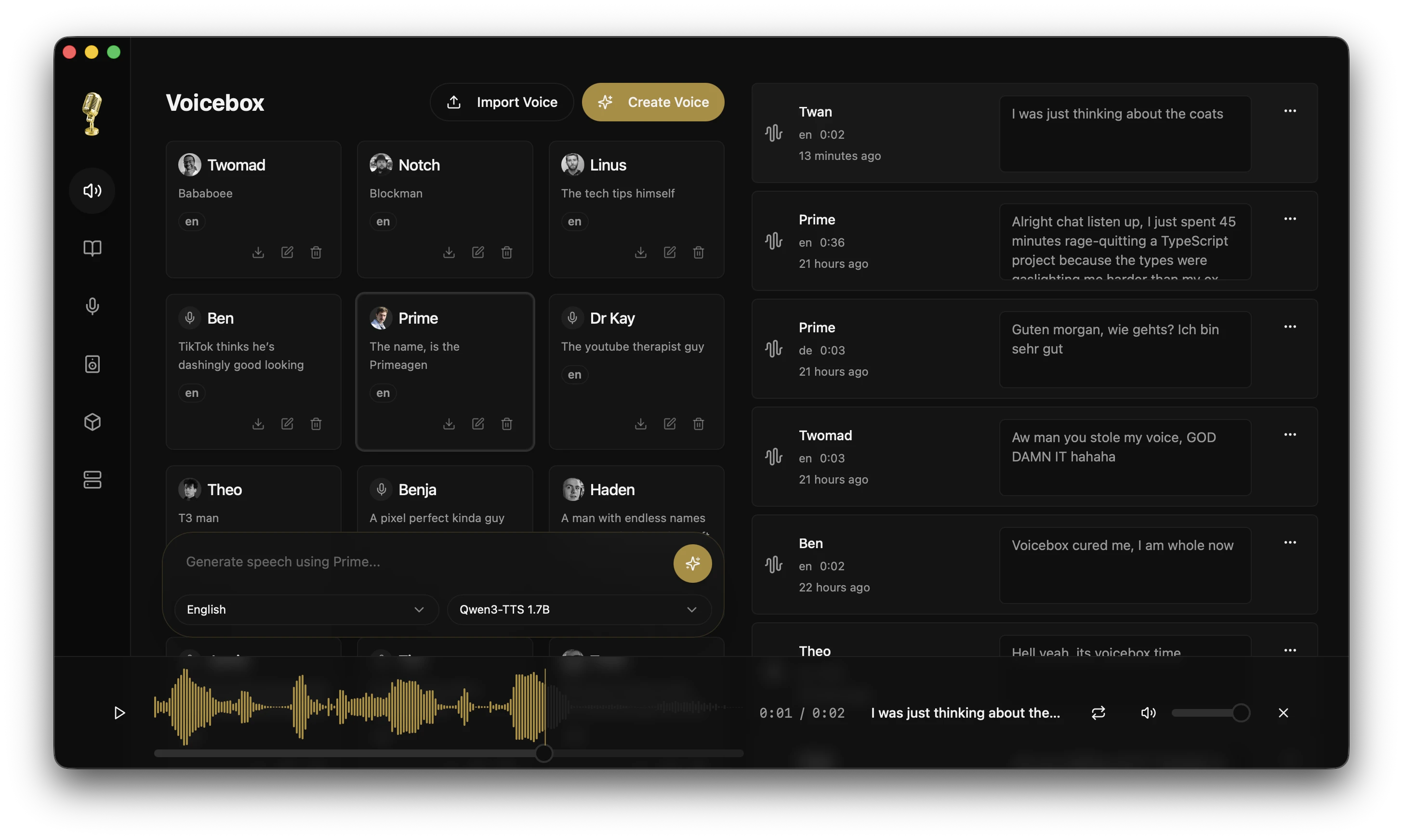
Click the image above to watch the demo video on voicebox.sh


What is Voicebox?
Voicebox is a local-first AI voice studio — a free and open-source alternative to ElevenLabs and WisprFlow in one app. Clone voices from a few seconds of audio, generate speech in 23 languages across 7 TTS engines, dictate into any text field with a global hotkey, and give any MCP-aware AI agent a voice of your choosing.
The two cloud incumbents sit on opposite halves of the voice I/O loop — ElevenLabs on output, WisprFlow on input. Voicebox does both, bridges them with a bundled local LLM for refinement and per-profile personas, and runs the whole thing on your machine.
- Complete privacy — models, voice data, and captures never leave your machine
- 7 TTS engines — Qwen3-TTS, Qwen CustomVoice, LuxTTS, Chatterbox Multilingual, Chatterbox Turbo, HumeAI TADA, and Kokoro
- Voice cloning and preset voices — zero-shot cloning from a reference sample, or 50+ curated preset voices via Kokoro and Qwen CustomVoice
- 23 languages — from English to Arabic, Japanese, Hindi, Swahili, and more
- Post-processing effects — pitch shift, reverb, delay, chorus, compression, and filters
- Expressive speech — paralinguistic tags like
[laugh],[sigh],[gasp]via Chatterbox Turbo; natural-language delivery control via Qwen CustomVoice - Unlimited length — auto-chunking with crossfade for scripts, articles, and chapters
- Stories editor — multi-track timeline for conversations, podcasts, and narratives
- Voice input — global dictation hotkey with push-to-talk and toggle modes, accessibility-verified auto-paste on macOS, in-app mic on every text field, Whisper-based STT
- Agent voice output — one tool call (
voicebox.speak) and any MCP-aware agent (Claude Code, Cursor, Cline) speaks to you in a voice you've cloned - Voice personalities — attach a free-form persona to any voice profile, then Compose, Rewrite, or Respond via a bundled local LLM — agents can invoke the same modes over MCP
- API-first — REST API plus a built-in MCP server for integrating voice I/O into your own apps and agents
- Native performance — built with Tauri (Rust), not Electron
- Runs everywhere — macOS (MLX/Metal), Windows (CUDA), Linux, AMD ROCm, Intel Arc, Docker
Download
| Platform | Download |
|---|---|
| macOS (Apple Silicon) | Download DMG |
| macOS (Intel) | Download DMG |
| Windows | Download MSI |
| Docker | docker compose up |
Linux — Pre-built binaries are not yet available. See voicebox.sh/linux-install for build-from-source instructions.
Having trouble? See the Troubleshooting Guide for common install, generation, model-download, and GPU issues.
Features
Multi-Engine Voice Cloning
Seven TTS engines with different strengths, switchable per-generation:
| Engine | Languages | Strengths |
|---|---|---|
| Qwen3-TTS (0.6B / 1.7B) | 10 | High-quality multilingual cloning, delivery instructions ("speak slowly", "whisper") |
| Qwen CustomVoice | 10 | 9 curated preset voices with natural-language delivery control — no reference audio required |
| LuxTTS | English | Lightweight (~1GB VRAM), 48kHz output, 150x realtime on CPU |
| Chatterbox Multilingual | 23 | Broadest language coverage — Arabic, Danish, Finnish, Greek, Hebrew, Hindi, Malay, Norwegian, Polish, Swahili, Swedish, Turkish and more |
| Chatterbox Turbo | English | Fast 350M model with paralinguistic emotion/sound tags |
| TADA (1B / 3B) | 10 | HumeAI speech-language model — 700s+ coherent audio, text-acoustic dual alignment |
| Kokoro | 8 | 50 curated preset voices, tiny 82M model, fast CPU inference |
Emotions & Paralinguistic Tags
Only Chatterbox Turbo interprets paralinguistic tags like [laugh] and
[sigh]. Qwen3-TTS, LuxTTS, Chatterbox Multilingual, and HumeAI TADA read them
literally as text.
With Chatterbox Turbo selected, type / in the text input to open the tag
inserter and add expressive tags inline with speech:
[laugh] [chuckle] [gasp] [cough] [sigh] [groan] [sniff] [shush] [clear throat]
Post-Processing Effects
8 audio effects powered by Spotify's pedalboard library. Apply after generation, preview in real time, build reusable presets.
| Effect | Description |
|---|---|
| Pitch Shift | Up or down by up to 12 semitones |
| Reverb | Configurable room size, damping, wet/dry mix |
| Delay | Echo with adjustable time, feedback, and mix |
| Chorus / Flanger | Modulated delay for metallic or lush textures |
| Compressor | Dynamic range compression |
| Gain | Volume adjustment (-40 to +40 dB) |
| High-Pass Filter | Remove low frequencies |
| Low-Pass Filter | Remove high frequencies |
Ships with 4 built-in presets (Robotic, Radio, Echo Chamber, Deep Voice) and supports custom presets. Effects can be assigned per-profile as defaults.
Unlimited Generation Length
Text is automatically split at sentence boundaries and each chunk is generated independently, then crossfaded together. Works with all engines.
- Configurable auto-chunking limit (100–5,000 chars)
- Crossfade slider (0–200ms) for smooth transitions
- Max text length: 50,000 characters
- Smart splitting respects abbreviations, CJK punctuation, and
[tags]
Generation Versions
Every generation supports multiple versions with provenance tracking:
- Original — clean TTS output, always preserved
- Effects versions — apply different effects chains from any source version
- Takes — regenerate with a new seed for variation
- Source tracking — each version records its lineage
- Favorites — star generations for quick access
Async Generation Queue
Generation is non-blocking. Submit and immediately start typing the next one.
- Serial execution queue prevents GPU contention
- Real-time SSE status streaming
- Failed generations can be retried
- Stale generations from crashes auto-recover on startup
Voice Profile Management
- Create profiles from audio files or record directly in-app
- Import/export profiles to share or back up
- Multi-sample support for higher quality cloning
- Per-profile default effects chains
- Organize with descriptions and language tags
Stories Editor
Multi-voice timeline editor for conversations, podcasts, and narratives.
- Multi-track composition with drag-and-drop
- Inline audio trimming and splitting
- Auto-playback with synchronized playhead
- Version pinning per track clip
Global Dictation & Voice Input
The other half of the voice I/O loop. Hold a hotkey anywhere on your system, speak, release — on macOS the transcript pastes straight into the focused text field. Or hit the mic on any Voicebox text input and dictate directly into the app.
- Configurable chord bindings — hold-to-speak and tap-to-toggle chords, each rebindable in the in-app chord picker. Holding push-to-talk and tapping
Spacemid-hold upgrades into a toggle session without a gap in audio - Target-aware paste (macOS) — accessibility-verified injection into the focused text field, with atomic clipboard save/restore so your clipboard isn't clobbered
- First-run permissions UX — in-app gates walk you through the macOS Accessibility and Input Monitoring grants with deep-links to System Settings
- In-app mic button on every Voicebox text field — generation form, profile descriptions, story titles, anywhere you'd type
- LLM refinement — optional cleanup of ums, stutters, and false starts before paste
- On-screen pill — floating overlay surfacing
recording,transcribing,refining, andspeakingstates. Same pill agents use when they speak to you, so there's one mental model for both directions of the loop
Speech-to-Text
Voicebox runs OpenAI Whisper for transcription — the same model that backs dictation, the Captures tab, and the /transcribe API. Running on MLX (Apple Silicon) or PyTorch (CUDA / ROCm / DirectML / CPU) depending on your platform.
| Size | Notes |
|---|---|
| Base / Small / Medium / Large | Standard Whisper quality ladder |
| Turbo | ~8x faster than Whisper Large, minimal quality loss |
More engines (Parakeet v3, Qwen3-ASR) are planned — see Roadmap.
Captures
Every dictation, in-app recording, and uploaded audio file lands in the Captures tab — original audio paired with transcript, always preserved.
- Replay, re-transcribe, refine — rerun STT with any Whisper size, or re-run the raw transcript through the local LLM with different flags (filler cleanup, self-correction removal, technical-term preservation)
- Edit inline — tweak the transcript and save on blur
- Play as voice profile — turn any capture into speech with a cloned voice, one click
- Promote to voice sample — use a capture's audio + transcript as a reference sample on any voice profile
- Local capture storage — original audio and transcript stay in your Voicebox data directory, with a folder shortcut in Settings
Agent Voice Output
Every agent gets a voice. One tool call and any MCP-aware agent can speak to you in a voice you've cloned — task completions, questions, notifications. The same pill that surfaces during dictation surfaces during agent speech, so you always see what's coming out of your machine.
// In any MCP-aware agent:
await voicebox.speak({
  text: "Deploy complete.",
  profile: "Morgan",
});
Also exposed as POST /speak for anything that doesn't speak MCP — ACP, A2A, shell scripts, custom harnesses.
- Bidirectional pill —
recording,transcribing,refining, andspeakingare all states of the same OS-level overlay, so dictation and agent speech share one surface - Per-agent voice binding — in Settings → MCP, pin Claude Code to Morgan and Cursor to Scarlett so you can tell which agent is talking without looking. Each client's
last_seen_attimestamp confirms the install actually took - Always visible — no silent background TTS; every agent-initiated speak surfaces the pill with the voice profile name for the full duration
- HTTP + stdio transports — install as a URL in Claude Code / Cursor / Windsurf / VS Code MCP, or point stdio-only clients at the bundled
voicebox-mcpbinary
Voice Personalities
Attach a free-form personality to any voice profile — who this voice is, how they speak, what they care about. Two actions appear on the generate box when a personality is set, powered by a bundled Qwen3 LLM running entirely locally.
- Compose — a shuffle button that drops a fresh in-character line into the textarea; edit and speak, or click again for a different take
- Speak in character — a toggle that routes your input text through the personality LLM to be rewritten in their voice before TTS
Agents can reach the same rewrite path over MCP by passing personality: true to voicebox.speak, turning the tool into a text-in → personality-LLM → TTS pipeline. The same LLM backs dictation's refinement step — one LLM in the app, one model cache, one GPU-memory footprint.
Local LLM options: Qwen3 0.6B / 1.7B / 4B, sharing the TTS runtime (MLX on Apple Silicon, PyTorch elsewhere).
Use cases: agent dev loops (dictate a question, hear the answer in a cloned voice), interactive characters for games and narrative tools, speech assistance for people who can't speak in their original voice.
Model Management
- Per-model unload to free GPU memory without deleting downloads
- Custom models directory via
VOICEBOX_MODELS_DIR - Model folder migration with progress tracking
- Download cancel/clear UI
GPU Support
| Platform | Backend | Notes |
|---|---|---|
| macOS (Apple Silicon) | MLX (Metal) | 4-5x faster via Neural Engine |
| Windows / Linux (NVIDIA) | PyTorch (CUDA) | Auto-downloads CUDA binary from within the app |
| Linux (AMD) | PyTorch (ROCm) | Auto-configures HSA_OVERRIDE_GFX_VERSION |
| Windows (any GPU) | DirectML | Universal Windows GPU support |
| Intel Arc | IPEX/XPU | Intel discrete GPU acceleration |
| Any | CPU | Works everywhere, just slower |
API
Voicebox exposes a REST API for integrating voice I/O into your own apps and agents.
# Generate speech
curl -X POST http://127.0.0.1:17493/generate \
  -H "Content-Type: application/json" \
  -d '{"text": "Hello world", "profile_id": "abc123", "language": "en"}'

# Agent voice output — any app or script can speak in a cloned voice
curl -X POST http://127.0.0.1:17493/speak \
  -H "Content-Type: application/json" \
  -H "X-Voicebox-Client-Id: my-script" \
  -d '{"text": "Deploy complete.", "profile": "Morgan"}'

# Transcribe an audio file
curl -X POST http://127.0.0.1:17493/transcribe \
  -F "[email protected]" \
  -F "model=whisper-turbo"

# List voice profiles
curl http://127.0.0.1:17493/profiles
POST /speak accepts profile as a name (case-insensitive) or id, and resolves via the same precedence as the MCP tool: explicit arg → per-client binding → capture_settings.default_playback_voice_id.
MCP server
Voicebox ships a built-in Model Context Protocol server so any MCP-aware agent (Claude Code, Cursor, Windsurf, Cline, VS Code MCP extensions) can speak, transcribe, and browse captures and profiles.
Claude Code one-liner:
claude mcp add voicebox \
  --transport http \
  --url http://127.0.0.1:17493/mcp \
  --header "X-Voicebox-Client-Id: claude-code"
Any HTTP MCP client (Cursor, Windsurf, VS Code, etc.):
{
  "mcpServers": {
    "voicebox": {
      "url": "http://127.0.0.1:17493/mcp",
      "headers": { "X-Voicebox-Client-Id": "cursor" }
    }
  }
}
Stdio fallback for clients that don't speak HTTP MCP — point at the bundled voicebox-mcp binary inside the app:
{
  "mcpServers": {
    "voicebox": {
      "command": "/Applications/Voicebox.app/Contents/MacOS/voicebox-mcp",
      "env": { "VOICEBOX_CLIENT_ID": "claude-desktop" }
    }
  }
}
Four tools ship: voicebox.speak, voicebox.transcribe, voicebox.list_captures, voicebox.list_profiles. Per-client voice bindings are managed in Voicebox → Settings → MCP. See the full MCP guide for tool signatures, resolution precedence, the speaking-pill contract, and security notes.
// In any MCP-aware agent:
await voicebox.speak({
  text: "Tests passing. Ready to merge.",
  profile: "Morgan",      // optional — falls back to the per-client binding
  personality: true,      // optional — rewrites text through the profile's personality LLM first
});
Use cases: agent dev loops (voice in, voice out), game dialogue, podcast production, accessibility tools, voice assistants, content automation.
Full API documentation available at http://127.0.0.1:17493/docs.
Tech Stack
| Layer | Technology |
|---|---|
| Desktop App | Tauri (Rust) |
| Frontend | React, TypeScript, Tailwind CSS |
| State | Zustand, React Query |
| Backend | FastAPI (Python) |
| TTS Engines | Qwen3-TTS, Qwen CustomVoice, LuxTTS, Chatterbox, Chatterbox Turbo, TADA, Kokoro |
| STT | Whisper / Whisper Turbo (PyTorch or MLX) |
| Local LLM | Qwen3 (0.6B / 1.7B / 4B), shared runtime with TTS / STT |
| MCP Server | FastMCP mounted at /mcp (Streamable HTTP) + bundled stdio shim binary |
| Native Shim | Rust (inside Tauri) for global hotkey, paste injection, focus introspection |
| Effects | Pedalboard (Spotify) |
| Inference | MLX (Apple Silicon) / PyTorch (CUDA/ROCm/XPU/CPU) |
| Database | SQLite |
| Audio | WaveSurfer.js, librosa |
Roadmap
| Feature | Description |
|---|---|
| Windows / Linux auto-paste | Dictation paste parity — SendInput on Windows, uinput / AT-SPI on Linux |
| STT engine expansion | Parakeet v3 and Qwen3-ASR joining Whisper — 50+ languages, better non-English quality |
| Pipeline routing | Configurable source → transform → sink chains with webhook + MCP sinks and a preset editor |
| Streaming transcription | WebSocket /transcribe/stream for partial transcripts as you speak |
| End-to-end speech LLMs | Moshi, GLM-4-Voice, Qwen2.5 Omni — real voice-to-voice, no text between |
| Voice Design | Create new voices from text descriptions |
| Long-form capture | Dual-stream recorder (mic + system audio) with summary LLM transform |
| Platform sinks | Apple Notes, Obsidian, and other opt-in integrations |
| Plugin architecture | Extend with custom models, transforms, and sinks |
| Mobile companion | Control Voicebox from your phone |
For the full engineering status, open-issue triage, and prioritized work queue, see docs/PROJECT_STATUS.md — a living document that tracks what's shipped, what's in-flight, candidate TTS engines under evaluation, and why we've accepted or backlogged specific integrations.
Development
See CONTRIBUTING.md for detailed setup and contribution guidelines.
Quick Start
git clone https://github.com/jamiepine/voicebox.git
cd voicebox

just setup   # creates Python venv, installs all deps
just dev     # starts backend + desktop app
Install just: brew install just or cargo install just. Run just --list to see all commands.
Prerequisites: Bun, Rust, Python 3.11+, Tauri Prerequisites, and Xcode on macOS.
The repo ships a pre-wired .mcp.json at the root — running Claude Code inside this checkout picks up the Voicebox MCP tools automatically once the dev app is running.
Building Locally
just build          # Build CPU server binary + Tauri app
just build-local    # (Windows) Build CPU + CUDA server binaries + Tauri app
Adding New Voice Models
The multi-engine architecture makes adding new TTS engines straightforward. A step-by-step guide covers the full process: dependency research, backend protocol implementation, frontend wiring, and PyInstaller bundling.
The guide is optimized for AI coding agents. An agent skill can pick up a model name and handle the entire integration autonomously — you just test the build locally.
Project Structure
voicebox/
├── app/              # Shared React frontend
├── tauri/            # Desktop app (Tauri + Rust)
├── web/              # Web deployment
├── backend/          # Python FastAPI server
├── landing/          # Marketing website
└── scripts/          # Build & release scripts
Contributing
Contributions welcome! See CONTRIBUTING.md for guidelines.
- Fork the repo
- Create a feature branch
- Make your changes
- Submit a PR
Security
Found a security vulnerability? Please report it responsibly. See SECURITY.md for details.
License
MIT License — see LICENSE for details.